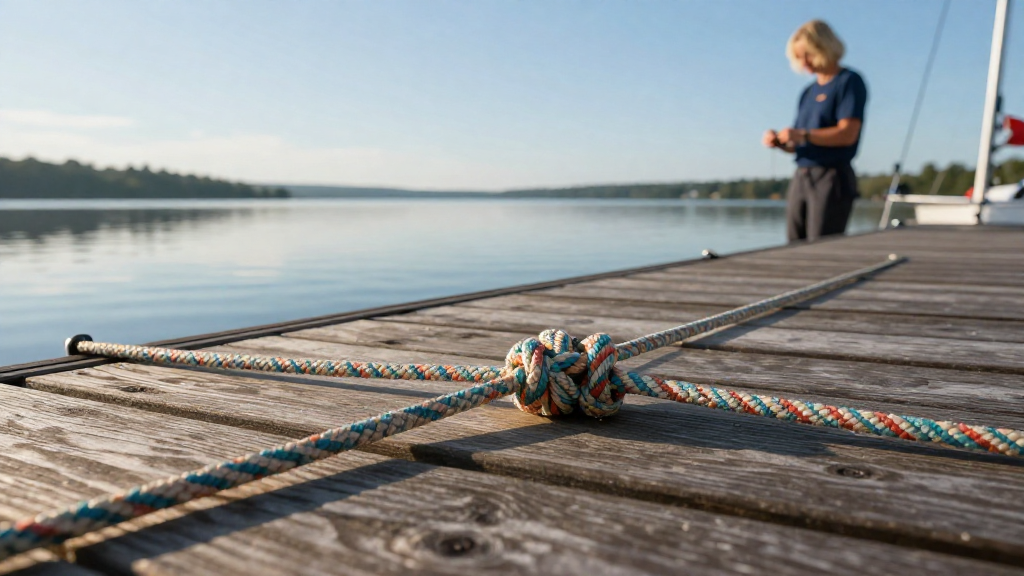
If you’re looking to enhance your boating experience, understanding how to tie boating knots is essential.
Knowing various knots will not only keep your boat secure but will also make your time on the water safer and more enjoyable. In this article, we will discuss how to tie five essential boating knots that every beginner should master.
Why Do You Need to Learn How to Tie Boating Knots?
Boating knots serve a variety of important purposes, such as:
- Securing a boat to a dock or another boat.
- Tethering equipment or gear.
- Adjusting sails and lines while sailing.
- Creating loops for easier handling.
Understanding how to tie boating knots will greatly enhance your skills and confidence as a sailor or boater.
How Can You Tie a Bowline Knot?
The Bowline knot is one of the most useful knots in boating.
It creates a fixed loop at the end of a line, making it ideal for securing objects or attaching lines to a boat.
To tie a Bowline knot, follow these steps:
- Form a loop in the rope, leaving a long end (the working end) and a short end (the standing part).
- Pass the working end through the loop from beneath.
- Wrap the working end around the standing part and back down through the loop.
- Pull tight while holding the standing part to secure the knot.
The Bowline knot is strong, easy to untie after being loaded, and is perfect for beginners learning how to tie boating knots.
What is the Best Way to Tie a Cleat Hitch?
The Cleat hitch is essential for securing your boat to a cleat.
It provides stability and allows for quick adjustments.
Here’s how to tie a Cleat hitch:
- Approach the cleat from the side and wrap the line around the base of the cleat.
- Make a figure-eight by crossing the line over itself.
- Wrap around the cleat again, moving toward the standing part of the line.
- Run the line underneath the cleat and pull tight.
The Cleat hitch is especially important to know when learning how to tie boating knots, as it ensures your boat remains secure when docked.
Can You Tie a Figure Eight Knot Easily?
The Figure Eight knot is another fundamental knot that every boater should know.
It’s primarily used as a stopper knot to prevent a line from slipping through a block or a pulley. To tie a Figure Eight knot, follow these steps:
- Make a loop with the line.
- Pass the working end behind the standing part and then through the loop.
- Pull tight to form a strong, secure knot.
The Figure Eight knot is highly reliable and easy to untie, making it an excellent addition to your boating knots repertoire.
How Do You Tie a Sheet Bend for Boat Lines?
The Sheet Bend is an excellent knot for joining two ropes of different diameters or materials.
This knot is highly versatile for attaching additional lines while sailing. Here’s how to tie a Sheet Bend:
- Form a loop in the larger line.
- Pass the smaller line (the working end) through the loop.
- Wrap it around the standing part of the larger line.
- Tuck it back into the loop created and pull tight.
The Sheet Bend is a fantastic choice when you’re learning how to tie boating knots, especially when you need a secure connection between two lines.
What is a Double Half-Hitch Knot and How Do You Tie It?
The Double Half-Hitch knot is notably easy to learn and provides a reliable way to secure lines.
It is commonly used to attach a line to a post or a ring. Here’s how to tie a Double Half-Hitch:
- Wrap the working end around the object you want to tie to (like a dock post).
- Bring the working end back over itself and feed it underneath.
- Repeat the process by making a second wrap and pull tight.
The Double Half-Hitch is simple yet effective, making it a staple knot for anyone learning how to tie boating knots.
Conclusion: Mastering Boating Knots
Learning how to tie boating knots is essential for anyone venturing out on the water.
By mastering these five knots—Bowline, Cleat Hitch, Figure Eight, Sheet Bend, and Double Half-Hitch—you will significantly improve your boating safety and efficiency.
Take the time to practice these knots on dry land before heading out on the water.
With practice, you’ll become proficient in how to tie boating knots, making each boating trip a smoother and more enjoyable experience.
Remember that mastering boating knots is a critical skill for all boaters, whether you are a beginner or an experienced sailor.
So grab your rope and get started!