ALLPOWERS VOLIX P300 review: this compact portable power station targets buyers who want simple backup power without carrying a large, heavy unit.
It stands out most for its LiFePO4 battery, fast AC charging, and built-in UPS switching.
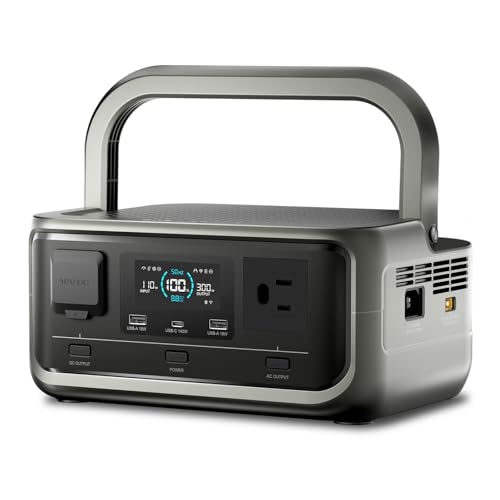
VOLIX P300 Review Summary
The ALLPOWERS VOLIX P300 is a good fit if you want a small, practical power station for laptops, routers, cameras, phones, and other everyday gear.
It is not trying to be a whole-home solution; it is aimed at portability, quick top-ups, and short-duration backup when the lights go out or when you are away from mains power.
Best for buyers who value compact size, fast recharge times, and straightforward backup capability. The listed LiFePO4 battery chemistry, 300W pure sine wave AC output, and <20ms UPS behavior make it especially relevant for light emergency backup and travel use where convenience matters more than maximum output.
Review Scorecard
| Category | Score | Why it scores here |
|---|---|---|
| Portability | 9/10 | At 7.87 lbs, it is easy to move for camping, travel, and emergency kits. |
| Backup usefulness | 8/10 | The <20ms UPS claim is a strong fit for routers, desktops, NAS, and gaming gear. |
| Charging speed | 8/10 | AC recharge in as little as 2 hours is a practical advantage. |
| Output flexibility | 7/10 | One AC outlet, 100W USB-C, two USB-A ports, and a car socket cover most small-device needs. |
| Battery longevity | 8/10 | The listed LiFePO4 pack rated for over 4,000 cycles suggests long service life. |
| Power headroom | 6/10 | 300W continuous output is useful, but it limits higher-draw appliances. |
| Value for use case | 8/10 | The feature set is focused and coherent for compact backup and travel power. |
Key Features and Specifications of VOLIX P300
The VOLIX P300 centers on a 256Wh LiFePO4 battery and a 300W pure sine wave AC inverter with 600W surge support.
That combination tells you exactly what kind of product this is: a compact utility station for small electronics, not a big inverter for power tools or large kitchen appliances.
The listing emphasizes several practical details:
- 256Wh battery capacity
- 300W pure sine wave AC output
- 600W surge support
- LiFePO4 battery chemistry
- Over 4,000 charge cycles
- AC charging in as little as 2 hours
- Up to 110W MPPT solar charging
- Car charging support
- One AC outlet
- One 100W USB-C PD port
- Two USB-A fast-charging ports
- One 12V car socket
- <20ms UPS switching
- 7.87 lb weight
- 6-year warranty
That spec sheet points to a very specific buyer profile.
If you want a unit you can keep in a closet, carry to a campsite, or use as a temporary desk-side backup, the size and output mix make sense.
If your priority is running larger appliances or maintaining long runtimes, the 256Wh capacity will feel intentionally modest.
The battery chemistry is one of the most important parts of the listing.
LiFePO4 is usually the more durable choice in this category, and the claim of more than 4,000 cycles suggests the unit is designed for repeated charging rather than occasional emergency-only storage.
For buyers who plan to use a power station often, that matters more than flashy peak numbers.
Pros and Cons of VOLIX P300
Pros
- Light enough to carry easily at 7.87 lbs
- Fast AC charging reduces downtime
- LiFePO4 chemistry supports long-term use
- UPS mode is useful for desktops, routers, and NAS devices
- 100W USB-C PD is well suited to laptops and modern mobile gear
- Clean pure sine wave AC output is better for sensitive electronics
- 6-year warranty is a strong confidence signal
Cons
- 300W continuous output is limited for high-draw appliances
- 256Wh capacity is better for short backup than long runtimes
- Only one AC outlet is listed
- It is not the right choice if you need heavy-duty household power
The biggest tradeoff is simple: the VOLIX P300 favors portability and daily convenience over raw capacity.
That makes it appealing for a lot of people, but only if their expectations match the class of product.
Who Should Buy VOLIX P300?
This is a sensible buy for campers, road-trippers, van-life users, photographers, remote workers, and anyone building a compact emergency kit.
It also makes sense for people who want a backup source for a WiFi router, desktop setup, or a few essential devices during short outages.
It is especially relevant if you want a small station that is easy to recharge quickly and easy to store between uses. The combination of AC fast charging, solar support, and UPS behavior gives it more flexibility than a basic battery bank, while still staying manageable to carry.
You should probably skip it if you need long runtime for power-hungry devices, or if you are shopping for something that can run larger appliances for extended periods.
The listed 300W output is a clear boundary.
That makes the product well defined, but it also means the buyer has to be realistic about the load.
If your priority is simple, dependable backup for electronics and small accessories, the VOLIX P300 fits the brief.
If you want a workhorse for larger off-grid living, you should move up to a higher-capacity station.
Backup Power and Travel Use
Fast recharge matters more than people think
The claim of AC charging in as little as 2 hours is one of the strongest practical features here.
For a compact power station, recharge speed changes how often you actually keep it ready.
A slow unit can drift into “I’ll charge it later” territory; a faster one is more likely to stay useful.
UPS behavior expands its desktop value
The <20ms UPS switching claim makes this more interesting than a typical weekend-camping battery.
That brief transfer window is aimed at protecting electronics that should not lose power abruptly, including routers, NAS systems, office gear, and gaming consoles.
That does not make it a full enterprise UPS, but it does make it more versatile than a simple emergency light source.
The port mix is practical, not excessive
The output set is balanced for modern small-device use: one AC outlet, one 100W USB-C PD port, two USB-A ports, and a 12V car socket.
That mix works well when one person wants to charge a laptop, phone, and camera at the same time, or when a family needs to split power across a few essentials.
LiFePO4 improves long-term ownership
The battery chemistry and cycle-life claim matter because they suggest the VOLIX P300 is built for more than occasional storage.
If you want a power station that can live in a cabinet, get used regularly, and still have a long service life, LiFePO4 is a logical advantage.
It is not a headline feature for everyone, but it is one of the strongest technical reasons to consider this model.
Alternatives to VOLIX P300
If you like the category but need a different balance of capacity, portability, or brand ecosystem, these Amazon search links are the closest comparison starting points:
- Jackery Explorer 300 portable power station
- EcoFlow River 2 portable power station
- BLUETTI EB3A portable power station
- Anker SOLIX portable power station
These are worth comparing if you want to check whether another compact station offers a better port mix, a different recharge profile, or a capacity bump that better fits your gear list.
Is VOLIX P300 Worth It?
Yes, if you want a compact LiFePO4 power station for light backup, travel, and small-device charging. The VOLIX P300 makes sense because its specs are coherent: portable weight, fast charging, UPS support, and a sensible set of everyday outputs.
It is not the universal answer in the portable power category, and it should not be treated like one.
The 300W limit and 256Wh capacity define the product clearly.
If that matches your needs, the model looks well positioned.
If you need higher power or longer runtime, look elsewhere.